
Marble in Iranian architecture
Marble has long been the material of choice for ancient civilizations. Marble lasts a long time, and marble structures represent the glory of the great cultures that once had power before they vanished. Iran and other nations saw the majestic beauty that marble stone offered and often utilized it to express their will and wealth. Iran, a country with many different stone quarries, had the resources necessary to do so. In this enlightening report, the aim is to point to some of the marble statues, monuments, and structures. These play a role in the history of Iran.

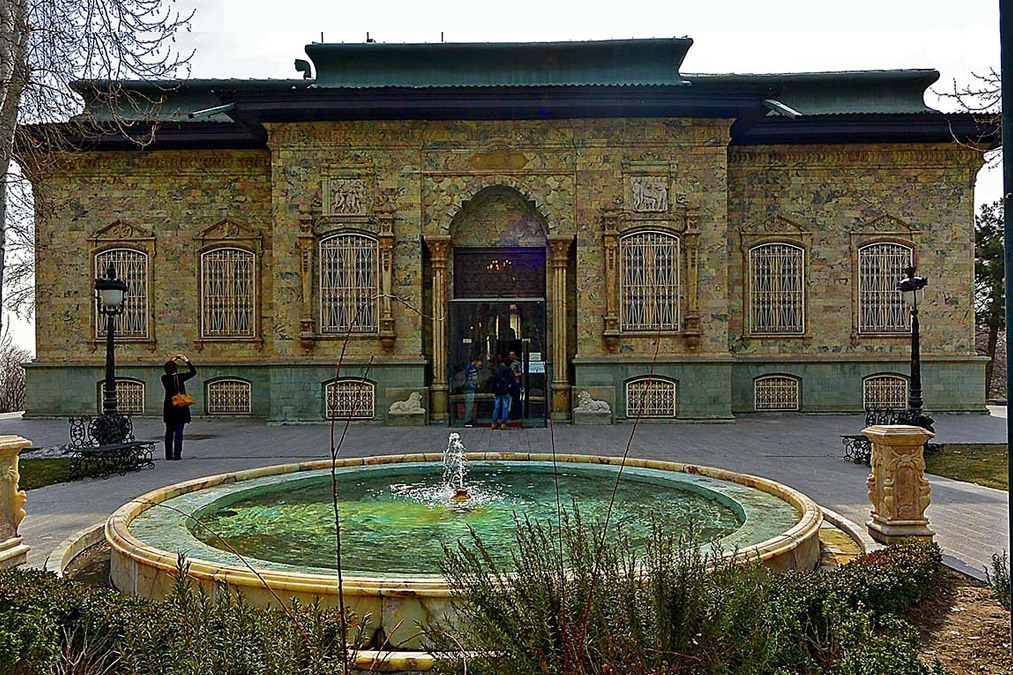
The green palace
This palace and now a museum used to be the Reza Shah’s resort in 1928. The green palace or the Shahvand palace is in the northwest wing of the Sa’ad Abad complex in the west north of Tehran. Its fame comes from the green marbles quarried from Zanjan and Khorasan covering its façade. The columns and the entrance are also from marble. These four white columns are gifts from the Carrara quarries in Italy.

The marble throne
This 250-year-old structure is in the Golestan Palace in Tehran. The terrace construction dates back to Karim Khan Zand’s reign. Agha Mohammad Khan wanted the terrace moved to Tehran. Later, Fathali Shah of the Qajar dynasty ordered the marble throne to be built just like the story of Solomon’s throne. The supports of the throne are, in fact, sculptures of women, men, and fairies holding the throne on their shoulders on the terrace. The throne’s height is 1.60 meters, and 65 slabs of marble build up its structure. On the four sides, three Dives and six angelic or human creatures are holding it up. You could spot a dragon and two lions on the sides of its stairs, as well.

Saadi statue in Shiraz by Sediqi
The eastern Michael Angelo or the famous AbolhassanSediqi is the creator of many statues, and some of those statues are from marble. Sa’adi’s statue is 3.1 meters high, and the association of arts and their representatives have approved this figure as the face of Sa’adi. Sediqi put a year and a half in carving this statute, and the artwork is outside the Esfahan gate of Shiraz, in a square called Sa’adi. Sa’adi was a famous poet from Shiraz whose shrine is still a place of gathering by his admirers. In recent years the statue has reportedly been moved to a square near his shrine called Pirnia.

Abu Ali Sina statue in Hamedan
Sediqi was Kamalolmolk’s student. Sediqi started his work in the field of sculptors under the supervision of his master. Among the many works of art of Sediqi, there is the statue of Avicenna. Abu Ali Sina, or as is known in the west Avicenna, is the great Persian philosopher, astronomer, and physician of his era. The statue is 3.1 meters high and is in the Avicenna Mausoleum in one of Hamedan’s squares called the Avicenna, respectively.


